Sparse-MDI
Adaptive Sparsification for Distributed Edge Inference
Reducing communication overhead in edge AI through intelligent network aware adaptive sparsity.
About the Project
Our research focuses on optimizing distributed edge AI systems through novel techniques
What is Sparse-MDI?
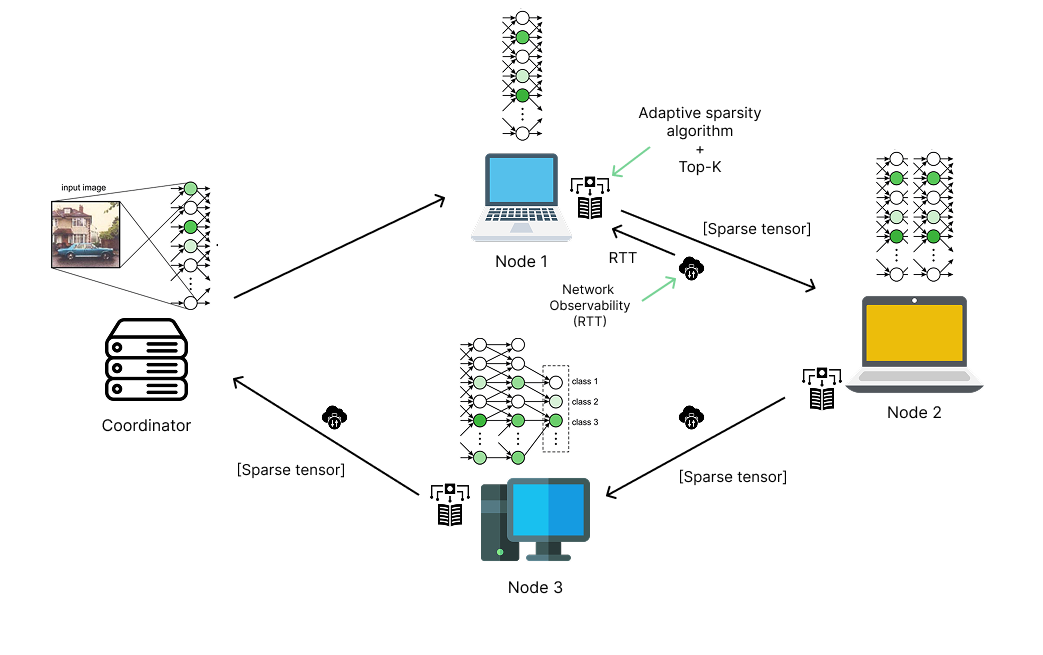
Sparse-MDI (Sparse Model Distributed Inference) is a research project built to optimize communication during inference in edge AI systems. By leveraging adaptive sparsification techniques, our approach significantly reduces the bandwidth requirements and latency challenges in distributed inference scenarios.
Our system addresses key challenges in edge AI deployment including high latency, bandwidth usage, and scalability concerns, making it suitable for resource-constrained environments like IoT networks and mobile device clusters.
Project Aim
This research aims to develop and evaluate a novel adaptive sparsification algorithm to optimise communication overhead in MDI while dynamically adapting to varying network conditions. Additionally, the research seeks to design and implement a peer-to-peer (P2P) MDI framework integrating the proposed algorithm, enabling real-world evaluation of its effectiveness.
Distributed Inference
Enables AI inference directly on distributed networks in edge networks, reducing cloud dependency and latency.
Optimized Communication
Reduces bandwidth requirements through adaptive sparsification techniques.
Improved Latency
Decreases response times for real-time applications through distributed processing.
GUI for Deployments
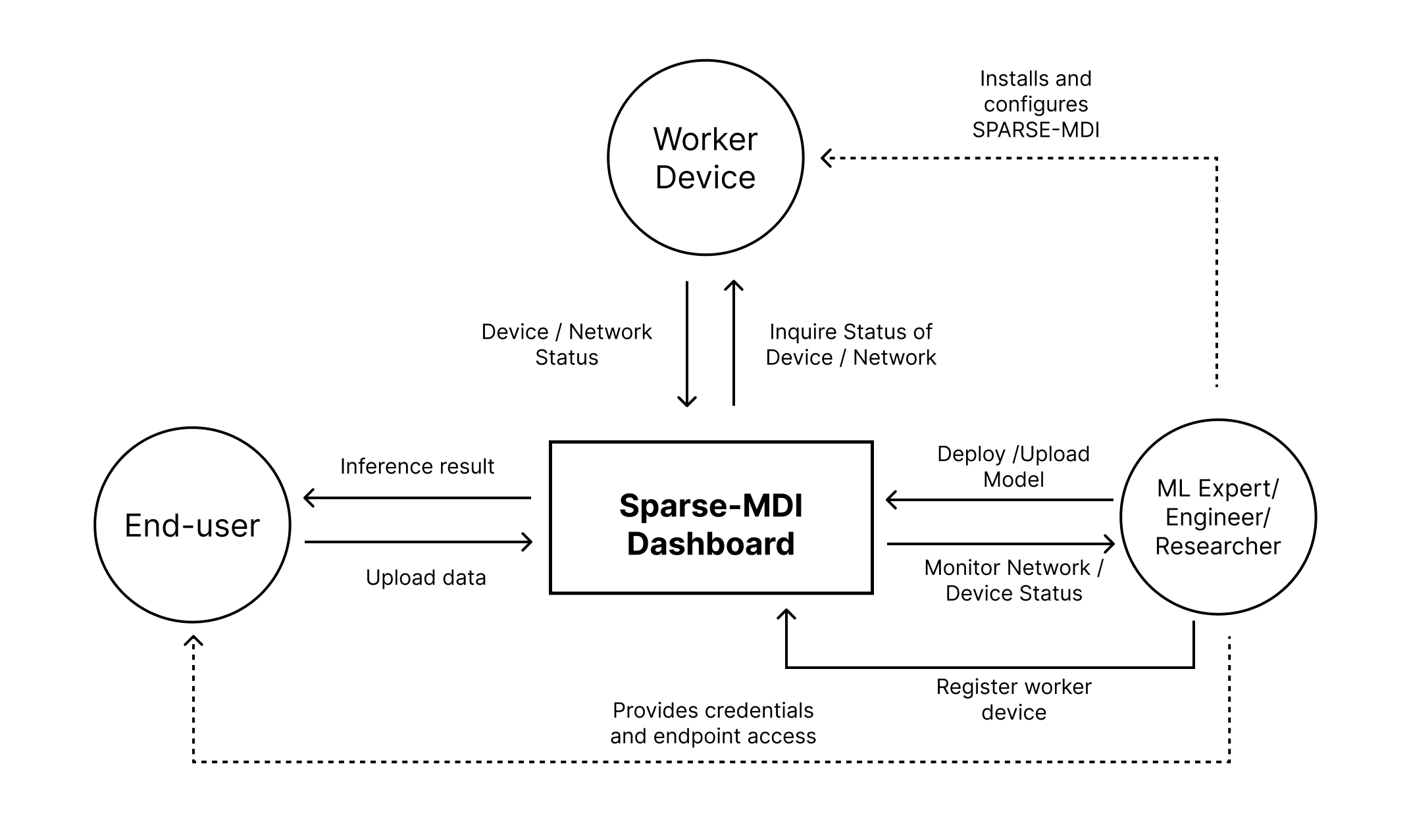
Sparse MDI comes with a interactive dashboard for deploying node configurations
Design Overview
This section presents the design and architectural foundation of the Sparse-MDI framework, with a focus on its design goals, system architecture, and adaptive sparsification algorithm.
Design Goals
Key objectives guiding the development of Sparse-MDI framework
| Design Goal | Description |
|---|---|
| Ease of Use | The system should be intuitive and easy to use with minimal learning curve. User interfaces must be intuitive for end-users. |
| Maintainability | The system must be extensible for new features and maintainable with good coding practices following proper coding standards. |
| Performance | The framework must be designed in a performance-oriented manner to maintain consistent model performance while minimizing the impact from unstable network conditions. The dashboard must also be responsive for optimal user experience. |
| Reusability | Components must be built in a flexible manner, allowing easy replacement for experimentation or improvement. |
| Scalability | Sparse-MDI must be scalable to support any practical number of nodes and handle models with moderate complexity, provided the cumulative resources meet the requirements. |
Framework Evaluation
A comprehensive overview of the Sparse-MDI framework testing results, highlighting the effectiveness of adaptive sparsification for distributed model inference.
Testing Overview
Communication Gain Across Models
Percentage reduction in communication overhead at different sparsity levels
ResNet-50 with 2-node configuration achieved 51.22% communication gain at 0.8 sparsity level, while MobileNet-V2 in 3-node configuration reached 46.61% gain.
Key Communication Findings
Summary of communication overhead reduction results
| Model Configuration | Max Communication Gain | Optimal Sparsity Level | Notes |
|---|---|---|---|
| ResNet-50 (2-node) | 51.22% | 0.8 | Consistent gains across sparsity levels |
| ResNet-50 (3-node) | 11.95% | 0.8 | Lower gains due to partitioning strategy |
| MobileNet-V2 (2-node) | -0.21% | N/A | Anomalous behavior with low-dimensional tensors |
| MobileNet-V2 (3-node) | 46.61% | 0.8 | Substantial gains with minor accuracy impact |
Testing Limitations
Constraints and considerations for interpreting test results
Test Environment
Testing was conducted on consumer hardware (Apple M2 with 8GB RAM) using Docker to emulate distributed systems, which may not fully represent real-world edge deployments.
Scope Constraints
Due to time and resource limitations, certain scenarios were deprioritized or omitted, including comprehensive Sparse vs. Adaptive analysis and deployment on actual edge devices.
Network Simulation
Network conditions were simulated rather than tested in real-world environments, which may impact the applicability of findings to actual deployment scenarios.
Further testing in real-world edge deployments is recommended to validate the framework's performance under authentic conditions.
Limitations & Future Directions
An assessment of current constraints and potential avenues for extending the Sparse-MDI framework and adaptive sparsification research.
Research Context
Framework Limitations
Current constraints of the Sparse-MDI implementation
Research Contributions
Current and potential contributions to the body of knowledge
Research Domain
The novel adaptive sparsity algorithm represents a significant contribution to the field of distributed AI inference, demonstrating how dynamic sparsification can balance communication efficiency and model accuracy in varying network conditions.
Technical Domain
The Sparse-MDI framework and dashboard provide practical tools for implementing and monitoring adaptive sparsification in distributed inference scenarios, offering a foundation for further research and development.
Supporting Resources
Pre-partitioned model repositories, dataset generation scripts, and CNN partitioning utilities offer valuable resources for researchers in the field, facilitating reproducibility and extension of this work.
By addressing the identified limitations and pursuing the outlined future directions, the impact and utility of these contributions can be significantly expanded.
Documentation
Access comprehensive documentation about Sparse-MDI
Contact Us
Get in touch with our research team or explore collaboration opportunities
Send us a Message
Fill out the form below and we'll get back to you as soon as possible.
Contact Information
Alternative ways to reach us
dovh.me@gmail.com
Phone
+94 (070) 277-6085
Location
Faculty of Computing
Informatics Institute of Technology
57 Ramakrishna Rd,
Colombo 00600, Sri Lanka